
EN
No Body Is an Island: Life, death and interconnectedness in Ida Lunden’s Tomb Womb
My Mother and I on a desolate plain of quiet crinkling, infinite expanses of cloth diapers and sheets.
We wash, we fold.
Murky, cool, undefined horizons.
Our hands’ repeated caresses. Our hands that touches, wipes off.
Balms, blood, urine, water, powder, pills, drops.
Everyday items that become sacred from us endlessly repeating the same handlings and rituals.
......
I si t in the company of they who are leaving this world, and they who are soon to be born.
Night and day cease to exist. Society cease s to exist.
I am in a transcendental state.
My consciousness is being expanded, by light and shadow.
………..
I finally rest by the bank of a crying river. I form vessels of bodies and I fill them with the liquid of sorrow. They who were always here, die, and they who did not exist before, crawls around me on the bank.
- Ida Lunden, 2021
Taking her point of departure in the sepulchral monument and in her personal experiences, Ida Lunden’s new sculptural work investigates our rituals and beliefs surrounding birth, death and remembrance. Insisting on love, on the immense potential inherent in grief and loss, and by making visible the material nature of care work, the artist seeks to foreground the fluid boundaries between giving life and facilitating death.
Throughout history and across cultures, humans have devoted a colossal portion of their time and resources towards tombs and rituals of death: Monuments are raised to rival mountains, vast, subterranean necropolises carved out over lifetimes, and from the desire for permanence elaborate memorials spring forth, while labor-intensive practices of embalming are deployed to protect the body from decomposition. As pilgrims flock to touch the relics of saints, finally, we observe that the material corpse possesses sacred, magical properties as indexical bridges between the living and the dead. Yet, many thinkers have pointed out how death’s visibility has in recent times undergone a transformation. While births are highly exposed events, death’s rituals have become increasingly concealed, seemingly relocated to the realm of the private grief. Paradoxically however, as Lunden argues, the act of bearing, birthing and raising a newborn is remarkably similar to that of caring for the dying.
During 2021, the artist found herself watching over her terminally ill father while simultaneously grappling with the role as a mother of an infant. Sickbed linens and cloth diapers intermingled, while tireless hands, carefully dosing and administering medicine, became full of holding and caressing, and diverging emotions fused in a fluctuating process of birthing, living, loving, caring and mourning.In this poignant time, Lunden began to observe and channel her own bodily memory of the gestures of care, while collecting materials to create sculptural reliefs informed by tombstones and sepulchral monuments. Her work culminated in the project Ornament & Care (with a performance feat. Louise Midjord, Rønnebæksholm, Næstved, DK, 2021).
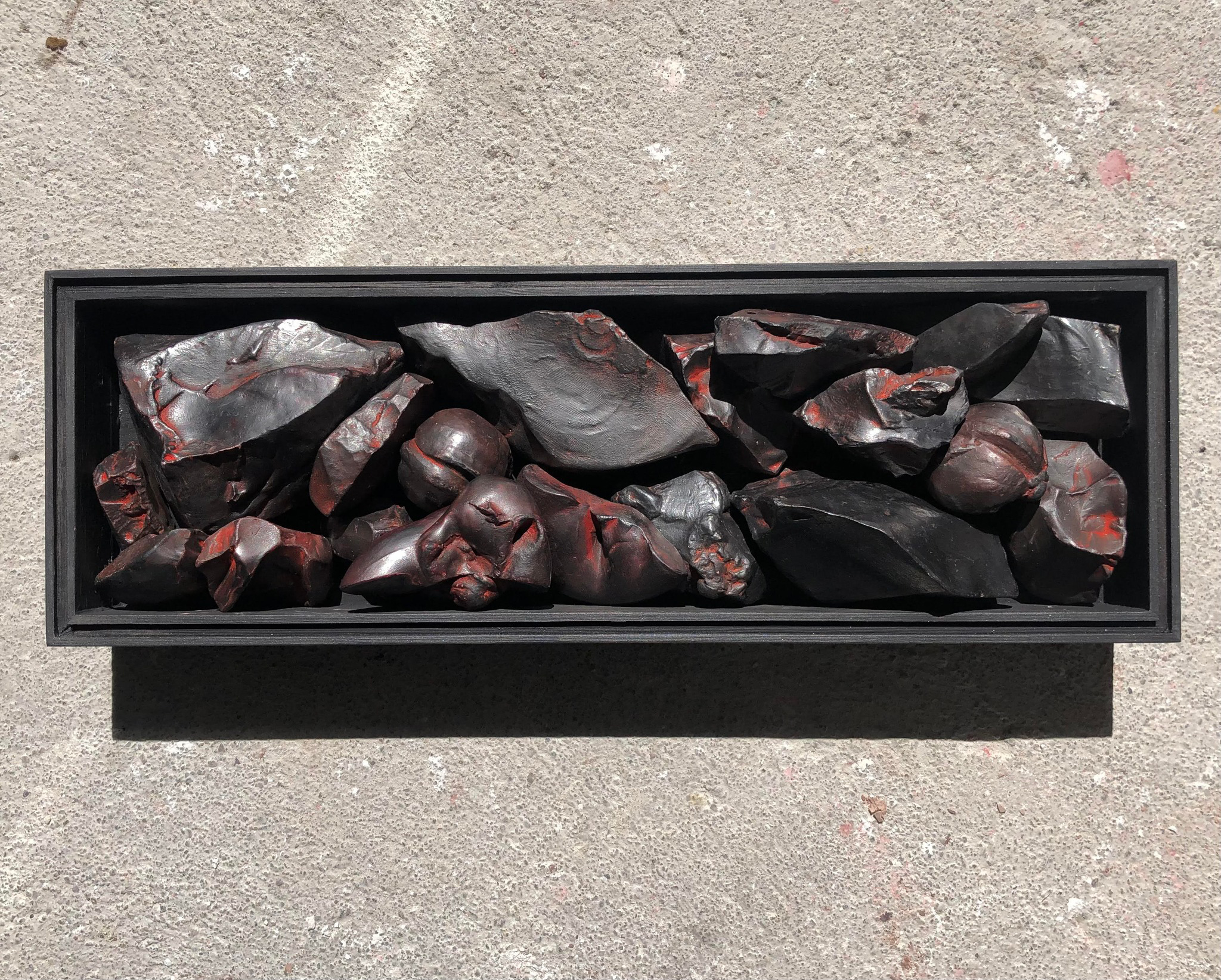
In Tomb Womb , Lunden continues her investigation, presenting a series of sensual, semi-anthropomorphic objects cast in plaster, juxtaposed with wooden vessels filled with water. The reliefs mirror the tradition of preserving relics and casting funeral masks of the dead, yet no sculpture bears direct likeness to recognizable subjects. Jettisoning hierarchies of medium and materials, Lunden made casts from the bodies of her family members, friends and colleagues, but also everyday items and detritus collected during the time of her grieving and maternity leave.
Wildly different forms taken from human bodies, and the materials and objects in and around them, fuse into flesh-and-bone-like sculptures with textures and surfaces that are sometimes sharply defined, and elsewhere, soft and undulating like organs. The reliefs are colored with graphite and pigments, which the artist repeatedly rubbed on, working the color into the casts with her fingers and palms, like an echo of the intimate caresses between family members.
Yet, by naming these objects relics, Lunden makes us aware of the material presence of original subjects inherent in them, and in extension, Tomb Womb encourages us to reconsider how we define life itself and how we mourn death. After all, a human body contains more non-human cells than human ones, and once we carefully explore the ontology of the matter, we learn that all things exist with, within-, and around their environment. Thus, the divide between organic and non-organic becomes difficult to maintain. Feminist and new-materialist philosophies of the 21st century are committed to bring about an alternative paradigm to Western enlightenment’s understanding of life as a linear process ultimately culminating in death. Here, events such as sickness and birth present liminal moments that threaten the status quo while simultaneously re-affirming life itself.
Lunden’s work emerges from personal experience, but in an epoch scientists and thinkers have named the Anthropocene, we are urgently required to consider the collective sickness and suffering of the planet, and to attend to the death of non-human others. As the world sweats and our so-called civilizations largely remain apathetic in the face of the sixth mass-extinction, we may recall that there is also wisdom to be gained in crises: No body is an island. Dying is always already an inherent part of living, and living means to gradually decay, as the atoms of our bodies continuously disperse into the cosmos in the entropic dance of becoming-molecular.
Ida Lunden (b. 1985, she/her) lives and works in Copenhagen, DK. She holds an MA from the Royal Danish Academy of Arts, School of Design (2015). Lunden’s artistic practice incorporates sculpture, graphics and performance in an experimental approach, committed to articulating the interconnectedness of the discursive and the material. Her recent solo work lends form to emotions and states of cohesion, grief and care, and death and mortality. Recent major exhibitions and performances, both solo and as the artist duo Morblod, include: Ornament & Care in Soil.Sickness.Society , Rønnebæksholm, Næstved, DK (2021, winner of the Bikuben Visionspris award); Morblod , Grafikernes Hus, Copenhagen, DK (2020); Mouth of Dancing Breath , CLICK Festival, Elsinore, DK (2020); Rite of H ydra , Huset for Kunst og Design, Holstebro, DK (2019), and Mediatrix , V1 Gallery, Copenhagen, DK (2017).